Best Time for a Golf Cart Tour in Rome: Time of Day & Season
Golf cart tours run throughout the year, so there is little reason to choose your Rome travel dates around the tour itself. Once your dates are fixed, the time of day you book usually matters more than the month: summer is best in the morning or evening, winter is most comfortable around midday, and spring and fall give you the most flexibility.
Use the date checker below to see the temperature, rain and sunset time for your travel day and choose the departure that suits the conditions.
The short answer
Rome golf cart tours are available year-round, and many use roofed carts with rain covers, so light rain is usually manageable. For the tour itself, the main choice is the start time. The heat, the light and whether the monuments are sunlit or floodlit all change through the day, and on an open-sided cart you feel the difference.
If you are still choosing dates for Rome as a whole, May and October are particularly comfortable months for sightseeing and also suit a golf cart tour well. Temperatures are generally much milder than in July and August, while January and February give you a quieter winter city break with shorter daylight.
Once your dates are fixed, choose the start time around the season. From June through September, book a morning or evening tour rather than an afternoon one. In July and August, afternoon temperatures are often around 31 °C (88 °F); a roof provides shade, but there is no air-conditioning and sightseeing stops are still outdoors.
From March to May and in October, temperatures are comfortable through most of the day, so morning, afternoon and sunset tours all work well. From November through February, a late-morning or midday start gives you the warmest part of the day, with the whole tour in daylight. If you want to see the Colosseum, the Trevi Fountain and other monuments illuminated, choose an evening tour that runs after dark instead.
Whatever the month, check the forecast for your date: operators may reschedule in a storm, and GetYourGuide bookings can be cancelled free up to 24 hours before. From late May into September, also check the Ministry of Health's heat alert for Rome; on high-risk heatwave days, the earliest morning departure is the better choice.
When you are visiting
Best start time
July and August
Morning or evening
June and September
Morning or evening
March to May, and October
Flexible: morning, afternoon or sunset
November to February
Late morning or midday
For illuminated monuments
Evening, after dark, year-round
Heatwave forecast
Earliest morning departure
Best months for a wider Rome trip
May and October
Most useful exact-date checks
Temperature · rain or storms · sunset · heat alert
Rome afternoon high, July and Augustabout 31 °C (88 °F)
Booking opens GetYourGuide in a new tab. We earn a commission if you book, at no extra cost to you.
Check dates and start times
Pick a date to see which start times are open for our featured tour, a two-hour ride from the Colosseum to the Trevi Fountain and the Spanish Steps with a gelato stop.
Check live availability and prices for this tour on GetYourGuide. Pоwered by GetYourGuide.
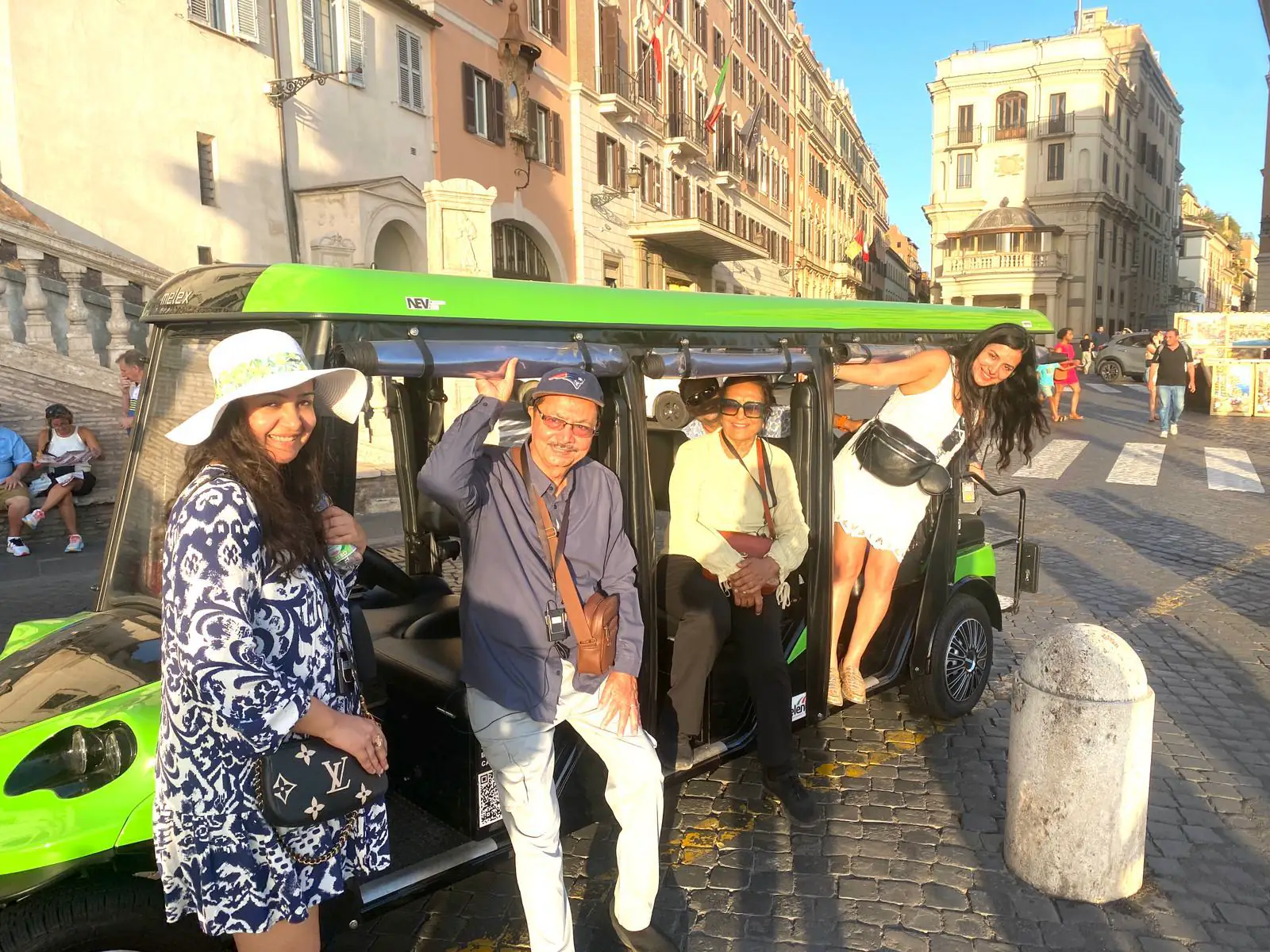
Many carts have a roof for shade, but the sides are open, so the start time makes a real difference to how comfortable the ride is.
Check your own date
Put in the day you want to ride. Within 16 days the card reads the live forecast for the morning, afternoon and evening; beyond that it shows Rome's long-term averages for that time of year, and it says which of the two you are looking at.
Typical conditions for a day in September
Long-term averages for September.
Afternoon27 °CAverage afternoon high for September. An average is not a promise about one day.
Evening17 °CAverage overnight low for September; evenings sit between the two.
Rain69 mmTotal for the whole of September, over about 6 wet days. Not a daily rate.
Sunset7:15pm
Days at 30 °C or aboveAbout 5 in September
Booking pressureAbove an average monthAccommodation arrivals across the Rome area run at 112 against an average month of 100. A demand indicator for the city, not a count of people on a tour.
Morning or evening; the afternoon can still be warm
Afternoons in mid-September average about 27 °C, with a few days at 30 °C or above early in the month. A morning tour, or an evening tour around sunset, is the comfortable choice.
The card shows the temperature and rain for your date, when the sun sets, how many hot days that month usually has, how busy Rome usually is and whether the date is a public holiday that can change the route. It does not know which start times are still open; the calendar above does.
Which start time to book
Most golf cart tours of Rome run two to three hours, and many tours are offered at more than one time of day: departures cluster around 9 or 10am, around 3pm and, for evening, sunset and night tours, between about 6:30 and 8pm in summer, depending on the operator. That choice is still open after your flights are booked.
Summer: June to early September
In July and August, a golf cart tour can be an easier way to see Rome than walking between every sight, but the start time still matters. Rome's afternoons average 28 °C in June and 31 °C in July and August, with 21 days at 30 °C or above in July and 22 in August. A roof keeps the sun off, but the cart is not air-conditioned, and at the stops the carts cannot drive into, such as the Trevi Fountain and Piazza Navona, you walk in the open. A morning tour gets the cooler part of the day and the monuments in daylight. An evening tour starts as the heat eases and finishes with the Colosseum and the fountains floodlit, because the sun does not set until after 8pm from May to mid-August. Whichever you pick, bring water: fewer than a quarter of the tours we compared include it.
Spring and fall: April, May, October
Afternoons average about 20 °C in April, 24 °C in May and 23 °C in October, so morning, afternoon and sunset tours all work well, and this is when a sunset tour is most comfortable. In October the sun sets earlier, and after the clocks go back at the end of the month it sets before 5:15pm, so more of an evening tour is floodlit rather than in daylight.
Winter: November to February
The sun sets between about 4:40 and 6pm and afternoons average 13 to 17 °C, falling to single figures at night. A tour around the middle of the day, from late morning to early afternoon, gets the warmest part of the day and the monuments in daylight. A tour that starts after sunset shows the monuments floodlit and leaves the daylight for sightseeing on foot; some operators move their evening departure earlier in winter, so check the start time on your date. The carts are open-sided, so bring a warm layer, and a few operators hand out blankets.
Keep exploring
Other Rome experiences you might enjoy
If the cart tour is one morning or evening of a longer Rome trip, these are the tours and tickets bookable now, from the Colosseum and the Vatican Museums to food tours in Trastevere.
Rome month by month for a cart tour
The tour itself is the same in every month. What changes is how warm the open cart is, how likely rain is, and whether an evening tour is in daylight or after dark.
Month
Afternoon high
Days at 30 °C+
Rain
Visitor demand
Sunset on the 15th
January
13 °C (56 °F)
0
61 mm, 8 wet days
67
5:04pm
February
14 °C (58 °F)
0
61 mm, 7 wet days
77
5:43pm
March
17 °C (62 °F)
0
54 mm, 6 wet days
95
6:16pm
April
20 °C (67 °F)
under 1
58 mm, 7 wet days
105
7:51pm
May
24 °C (75 °F)
under 1
54 mm, 6 wet days
118
8:23pm
June
28 °C (83 °F)
10
27 mm, 3 wet days
117
8:47pm
July
31 °C (88 °F)
21
17 mm, 2 wet days
118
8:44pm
August
31 °C (89 °F)
22
27 mm, 2 wet days
102
8:11pm
September
27 °C (80 °F)
5
69 mm, 6 wet days
112
7:20pm
October
23 °C (73 °F)
0
95 mm, 8 wet days
117
6:29pm
November
17 °C (63 °F)
0
120 mm, 10 wet days
91
4:50pm
December
14 °C (57 °F)
0
86 mm, 9 wet days
80
4:40pm
How to read it: the rain column is the total for the whole month, with the number of days that get at least 1 mm beside it, not a daily rate. Visitor demand compares each month with an average month of 100. Sunset times are for the 15th of each month, with summer time applied.
June to August is dry and hot. July averages only about two wet days, so rain almost never affects a summer tour, and heat is the thing to plan around. September keeps most of the summer warmth, with around five days at 30 °C or above, mostly early in the month. October and November are the wettest months, at about 95 mm and 120 mm, which is where the carts' rain covers earn their keep. December to February is cool and short-days, with sunset around 5pm, but a clear winter morning on a cart is comfortable in a coat.
When Rome is busiest
A cart takes the walking out of the tour, but not the crowds at the stops it cannot enter: at the Trevi Fountain, Piazza Navona and the Pantheon you get out and walk in among everyone else. Italy's statistics office publishes the number of people checking into accommodation in the Rome area every month, which is the best monthly guide to how busy the city is.
January and February are the quietest months, with arrivals about a third and about a quarter below an average month.
May, June, July and October are the busiest, all around 17 to 18 percent above an average month.
August dips back to about average for accommodation arrivals, although Fiumicino airport is at its busiest then, with Romans leaving on holiday as well as visitors arriving.
This counts check-ins across the whole metropolitan area, not people at the Trevi Fountain or on a cart, so read it as a guide to demand in the city.
Rain, heat and cold on an open cart
Rain. Many tours use carts with a roof and roll-down plastic side covers, and several operators hand out ponchos. Not every cart has them, so check the vehicle details when you book. Many listings, including our featured tour, say the tour still takes place in rainy weather, and one operator says that in a thunderstorm it waits in a café for the rain to pass before carrying on. In a storm operators may reschedule, although few publish exactly what happens, so check your tour's own policy. Tours booked on GetYourGuide can be cancelled for a full refund up to 24 hours before the start.
Heat. From late May to September, Italy's Ministry of Health publishes a daily heat bulletin for Rome with levels from 0 to 3, where level 3 means high-risk conditions for three or more days in a row. On a level 2 or 3 day, take the earliest tour you can, carry water and a hat, and avoid the early afternoon on foot.
Cold. Winter afternoons in Rome average 13 to 14 °C and nights fall to about 4 °C. The cart's open sides let the air through, so an evening tour from November to February calls for a warm coat.
Dates that can change the route
Tours run on most holidays, but a few dates change which streets a cart can use, and operators adjust their itineraries around them.
Public holidays. Via dei Fori Imperiali, the road between the Colosseum and Piazza Venezia, is closed to traffic and becomes a pedestrian street on public holidays.
June 2, Republic Day. The military parade closes the streets around the Colosseum and Piazza Venezia from early morning, with roads reopening gradually from 2pm; Via dei Fori Imperiali stays closed all day.
Good Friday. The Pope's Way of the Cross at the Colosseum closes the area around it to traffic from early afternoon until late evening.
Christmas Day and New Year's Day. The main tours' booking calendars still show these dates, but the Pantheon is closed to visitors on both, so you will see it only from the outside.
The Trevi Fountain. Since February 2026, going down the steps to the fountain's basin needs a €2 ticket. Check whether your tour includes it.
If your date falls on one of these, check the itinerary on your booking; operators note that routes can vary with road closures.
Which tour suits which time
Three tours cover the choices this guide describes.
A morning or midday tour
Our featured two-hour tour from the Colosseum past the Circus Maximus, Piazza Venezia and the Trevi Fountain to the Spanish Steps, with a gelato stop. Choose an early slot in summer and a midday one in winter.
A three-hour tour after dark, with the monuments floodlit, from the Spanish Steps and the Trevi Fountain to the Colosseum. The cool choice in July and August.
Is a golf cart tour of Rome better in the morning or the evening?
It depends on the season. From June to August both are better than the afternoon, when Rome averages 28 to 31 °C: the morning is the cooler daylight option and the evening shows the monuments at sunset or floodlit. From November to February the sun sets before 6pm, so a tour around the middle of the day gets the warmest daylight, and a tour that starts after sunset shows the monuments floodlit. Spring and fall give you the most flexibility.
What is the best month for a golf cart tour in Rome?
There is no single best month for the tour itself, because golf cart tours run all year. If you are still choosing dates for Rome as a whole, May and October are particularly comfortable months for sightseeing, with afternoon highs of about 22 to 24 °C (72 to 75 °F), and they suit a cart tour well. Once your dates are fixed, the more useful choice is the time of day.
Do golf cart tours in Rome run in the rain?
Usually, yes. Many tours use roofed carts with roll-down plastic side covers, and many listings, including our featured tour, say the tour still takes place in rainy weather. Check the vehicle details when you book. In a storm, operators may reschedule. Tours booked on GetYourGuide can be cancelled for a full refund up to 24 hours before the start.
Is a golf cart tour a good idea in Rome in August?
Yes, if you choose the hour. August afternoons in Rome average about 31 °C (88 °F), with around 22 days at 30 °C or above, and a roof gives shade, but the cart is not air-conditioned. Book a morning tour or an evening, sunset or night tour, bring water, and check Italy's heat bulletin for Rome before you go.
Do Rome golf cart tours run in winter?
Yes. None of the operators we checked publishes a closed season, and the main tours' booking calendars include January, February and Christmas week. Afternoons average 13 to 14 °C from December to February, the sun sets between about 4:40 and 6pm, and the carts are open-sided, so bring a warm layer.
What time do night golf cart tours in Rome start?
In summer, evening and night tours usually leave between about 6:30 and 8pm, depending on the operator. Some operators move their evening tour earlier in winter, when it is dark before 5:30pm, so check the start time for your own date on the booking page.
Do golf cart tours run on public holidays in Rome?
Generally, yes, but the route can change. Via dei Fori Imperiali, the road past the Colosseum and the Forum, is pedestrian-only on public holidays and closed to traffic all day on June 2 for the Republic Day parade. Check your tour's itinerary if your date falls on a holiday.
How we know
Temperatures. The 1991–2020 climate normals published by ISPRA, Italy's environmental protection institute, for the Aeronautica Militare station at Roma Urbe (WMO 16235), the national weather service's station nearest the historic center. Afternoon highs, night lows and days at 30 °C or above all come from that station.
Rain. ISPRA's 1991–2020 rainfall normals for Roma Collegio Romano, the historic station in the center of Rome, because ISPRA publishes no 1991–2020 rainfall series for Roma Urbe.
Visitor demand.ISTAT, monthly arrivals at all accommodation in the Città metropolitana di Roma, calendar year 2024, indexed against that year's average month. 2025 was a Jubilee year and is left out. Fiumicino airport's monthly passenger totals from Assaeroporti were used as a cross-check.
Sunset times. Computed with the NOAA solar-position method for central Rome, in Italian time with summer time applied. They are calculated rather than observed and are good to within a few minutes.
Tours. 107 golf cart city tour listings on GetYourGuide and the websites of seven Rome operators, read on September 18, 2026, for durations, departure times, what the carts are fitted with and what happens in rain.
Dates and rules. Roma Mobilità and Roma Capitale notices for holiday road closures, the Trevi Fountain ticket and the Pantheon's closing days, and Italy's Ministry of Health for the heat bulletins.
Where this evidence stops.
Monthly averages describe a typical month in 1991–2020 and are not a forecast; the date checker's live forecast covers the next 16 days.
The visitor figures count accommodation check-ins across the Rome area. They are a proxy for demand in the city: the series does not count day visitors, people at any stop or people on any tour.
Departure times and cart equipment vary by operator. We could not read the exact start times on every featured tour, so this guide describes the usual pattern and the booking calendar gives the times for your date.
Rome is discussing new rules for tourist golf carts in the historic center. As of September 18, 2026 none is in force, but routes could change if rules are adopted, so check your tour's itinerary close to your date.
We do not have per-date prices, so this guide makes no claim about which month is cheapest.
Ready to roll
Pick the start time that suits your day
Whatever month you are in Rome, the choice is the same: a morning or evening ride in summer, one around the middle of the day in winter, and any of them in spring and fall. Then check it is open on your date.