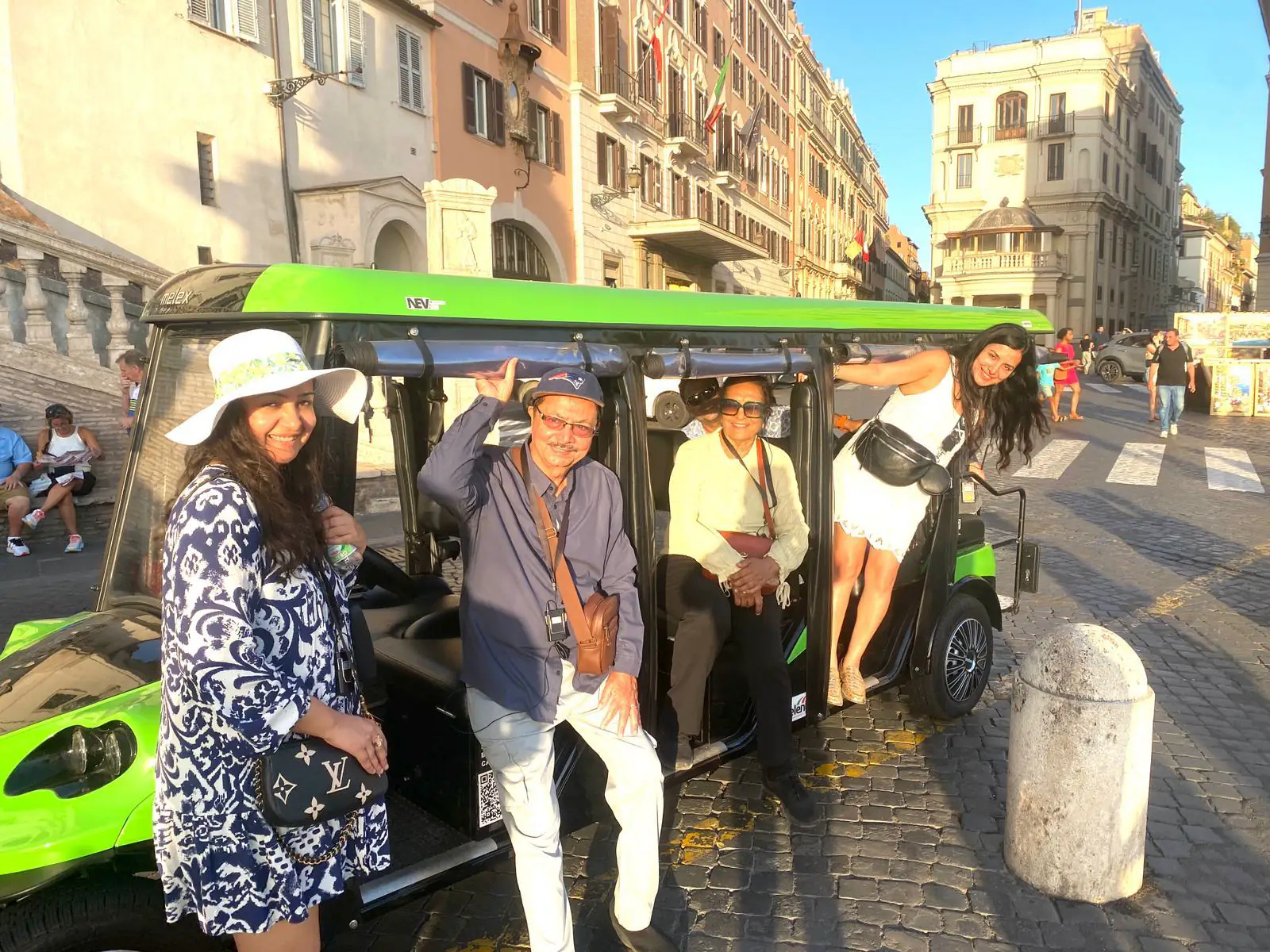
Rome's winter is mild, but a cart ride feels colder than the forecast. Here is how to dress for it, month by month.
Every photo stop means stepping off the cart onto stone, so shoes matter as much as coats.
Wear one more layer than the thermometer suggests: a warm, wind-blocking and ideally water-resistant jacket over a thin thermal base and a fleece or sweater, plus a scarf, light gloves and closed, grippy waterproof shoes. You'll be sitting still in a vehicle with open or half-covered sides, and the moving air makes Rome's mild 12–16°C afternoons and 3–8°C evenings feel several degrees colder.
Check live availability and prices for this tour on GetYourGuide. Pоwered by GetYourGuide.
The calendar above is for City Walkers Tours' Golf Cart Tour with Artisanal Gelato Tasting (from $45 per person, 4.8/5 from 2,892 reviews), the most-reviewed golf cart tour in Rome on GetYourGuide. Its listing says the tour still happens in rainy weather and doesn't allow luggage, large bags or baby carriages on board, so dress for the weather and travel light.
Quick answer
Dress for how it feels, not the forecast. At around 20 km/h, an 8°C December evening feels like about 5°C on exposed skin, and a 4°C January night feels close to 0°C. A windproof outer layer, a scarf and gloves matter most.
Feet and hands get cold first. Cart rain panels don't reach the floor, so wear waterproof shoes with good grip for wet sampietrini (cobblestones), and pack touchscreen gloves and a couple of disposable hand warmers.
Keep it compact and church-ready. Bring a small crossbody bag only, since many listings ban luggage, large bags and often strollers. Keep a layer that covers your shoulders, and wear trousers or a skirt to the knee for church stops such as the Pantheon or St Peter's.
Mild but damp. Climate-data.org puts average highs at 16.3°C in November, 12.5°C in December, 11.4°C in January and 12.1°C in February, with lows of 3.5–9°C. Its average relative humidity is 79% in November, December and January and 76% in February.
Frequent rain, rarely all day. Climate-data.org names November the wettest month, with an average of 135 mm (5.3 inches) of rainfall over 9 rainy days. December averages 8 rainy days, and January and February 7 each.
Freezing nights happen. According to Current Results, Rome averages 9 nights at or below 0°C in January, 7 in both December and February, and 2 in November, "a typical total of 28 nights a year", although "most of those cold nights dip down to just slightly below freezing."
Operators tell you to bring layers. The Roman Guy's small-group cart tour advises "rain gear and an extra layer if the weather looks questionable, as the vehicle is open-air". An Airbnb golf cart host asks winter guests "to dress warmly with a good coat and perhaps gloves". Rolling Rome's winter page recommends "a warm sweater, a light jacket, and a reliable waterproof or water-resistant outer coat", plus sturdy walking shoes.
Blankets help, but they aren't heating.My Best Tour lists a winter kit of plastic covers, ponchos and blankets, and Turtle Tour Rome supplies rain covers and ponchos. No cart is heated, so your own clothing does most of the work.
Keep exploring
Other experiences you might enjoy
Warm indoor visits pair well with a winter cart ride: the Vatican Museums and St Peter's Basilica, the Pantheon, the Borghese Gallery, evening food tours in Trastevere and pasta-making classes in central Rome.
Rome winter temperatures and what to wear, month by month
Averages vary a little between climate sources. The figures below use climate-data.org highs and lows, cross-checked against Weather Atlas and Current Results. Sunset times are for the dates shown.
Month
Average high / low
Rainy days
Sunset (approx.)
Day tour outfit
Night tour outfit
November
16°C / 9°C
~9
16:53 (13 Nov)
Long-sleeve top, light sweater and water-resistant jacket; scarf in your bag
Add a fleece or packable down jacket, a scarf and light gloves
December
12.5°C / 5°C
~8
16:41 (21 Dec)
Thermal top, sweater and an insulated, wind-resistant coat; scarf
Full winter kit: warm coat, hat and gloves; thermal leggings optional
January
11.4°C / 3.5°C
~7
17:04 (15 Jan)
Thermal base, fleece and warm coat; hat and gloves
The warmest outfit of the year: thermal top and bottoms, down coat, hat, gloves and warm socks
February
12°C / 3.5°C
~7
17:43 (15 Feb)
As January on cold days; swap the hat for a scarf on sunny afternoons
As January
What this means in practice: November feels like a cool autumn in northern Europe. From December on, any tour that ends after sunset, which in December can be well before 5 pm, needs real winter clothing; a light jacket won't do.
Why a golf cart feels colder than walking
In the historic centre, with its traffic, cobbles and frequent stops, tour carts typically move at roughly 15–25 km/h between stops, and you're sitting still instead of warming up by walking. The standard wind chill index (used by Environment Canada and the US National Weather Service) gives a sense of the effect on exposed skin. The US National Weather Service notes that wind chill "is only defined for temperatures at or below 50°F [10°C] and wind speeds above 3 mph."
Air temperature
Air speed over skin
Approximate "feels like"
10°C
25 km/h
~7°C
8°C
20 km/h
~5°C
6°C
15 km/h
~3°C
4°C
20 km/h
~0°C
3°C
20 km/h
~-1.5°C
These are our calculations with the published formula. The real effect is smaller behind a windscreen and roof, and bigger when the tramontana is blowing. Merriam-Webster defines the tramontana as "a dry cold strong northerly wind of the west coast of Italy". It is most common in winter, and on those days the sky is often brilliantly clear, so a sunny forecast doesn't mean a warm one. Rome's average humidity of 76–79% also makes the cold feel more penetrating, which is why wind-blocking and insulating layers matter more than sheer bulk.
How to layer for a winter golf cart tour
Think in three layers you can adjust when you hop off at the Trevi Fountain or the Gianicolo viewpoint:
Base layer: a thin thermal or merino long-sleeve top, plus thermal leggings under your trousers on December to February evenings. Avoid cotton next to the skin if rain is forecast, because it stays cold when damp.
Mid layer: a fleece, a wool sweater or a thin packable down jacket. This is the layer you'll take off inside a church or café.
Outer layer: a wind-resistant, water-resistant jacket or coat with a hood, long enough to cover your hips while seated. A mid-thigh parka or quilted coat beats a cropped jacket on a cart bench.
Dress like a Roman
Romans dress for winter early and fairly formally. Dark wool coats, quilted or down jackets, a generous scarf, dark jeans or tailored trousers and leather boots or clean sneakers are the norm. Neutral colours such as navy, black, camel and grey photograph well against travertine and won't leave you underdressed at dinner afterwards. Shorts and flip-flops in December mark you instantly as a tourist.
Footwear for wet sampietrini
Rome's black basalt cobblestones, the sampietrini, are uneven and slippery when wet, and you'll step on and off the cart dozens of times. Rolling Rome warns guests not to "underestimate the need for comfortable, sturdy walking shoes for your time off the cart".
Best: waterproof leather or Gore-Tex-style sneakers or ankle boots with a rubber lugged sole.
Fine on dry days: regular sneakers with good tread, with spare socks in your bag.
Avoid: smooth leather soles, heels, ballet flats and canvas shoes on rainy days.
As our rain covers and blankets guide explains, side panels don't seal at floor level, so wet feet are the most common winter complaint. Wool-blend socks keep your feet warm even if they get damp.
Winter accessories to pack
Touchscreen gloves, so you can take photos without exposing your fingers.
A beanie or ear warmer: the roof keeps the rain off, but the wind still reaches your ears.
A large scarf or pashmina, which keeps you warm and doubles as a shoulder cover for churches.
A compact umbrella for the walking stops only; never open one on a moving cart. Some operators, Turtle Tour Rome among them, include an umbrella or ponchos.
A packable rain jacket or poncho, useful if your operator doesn't supply one.
Sunglasses: the low winter sun can be surprisingly glaring on bright tramontana days.
Hand warmers: disposable air-activated hand warmers (scaldamani) are sold in Italian pharmacies for roughly €2 a pair.
A power bank: cold drains phone batteries faster, and you'll be using your camera constantly.
Phone protection: a waterproof pouch or a simple zip bag for drizzle.
Day or night: how your outfit should change
A daytime tour in sunshine can feel pleasant, and you may unzip your coat at the photo stops. Night tours are colder: the temperature drops quickly after sunset, the stone city loses its stored warmth and there's no sun on your face. The Tour Guy's Rome by Night golf cart tour tells guests that "during the winter months, be sure to bring a jacket". We'd add a hat, gloves and a thermal base. Our guide to Rome at night by golf cart covers the floodlit route and the night tours.
Dressing children and older travellers
Children lose heat faster and wriggle out from under blankets. Dress them in a one-piece base layer, a hat that covers the ears, mittens on a string for little ones and waterproof boots. Check the age limits on GetYourGuide: Loving Rome's City Highlights Golf Cart Tour is "Not suitable for: Children under 3 years", and Parisa in Rome's Private Golf Cart Tour with Artisanal Gelato excludes "Children under 6 years". Turtle Tour Rome notes that children can't sit on laps under Italian traffic rules and provides car seats or boosters on request.
Older travellers should put warmth before style: a long coat that covers the lower back while seated, thermal leggings, non-slip soles and a lap blanket (ask the operator in advance). Stepping off a cart onto wet stone is the main fall risk, so supportive shoes matter more than anything else.
Church dress code: shoulders and knees
Many routes pass churches, and some stop inside. The official St Peter's Basilica site states that clothing must have "shoulders and knees covered". The Pantheon is an active Catholic basilica, Santa Maria ad Martyres, with a ticketed entry, and modest dress is expected there too; enforcement is looser than at St Peter's, but don't count on it. Turtle Tour Rome's FAQ says there is no tour dress code, but "to go into churches, please have your shoulders covered". Winter makes this easy: keep your mid layer on and skip short skirts. Some operators supply scarves for covering up, including My Best Tour, whose 3-Hour Private Golf Cart Tour lists them as included. Hats come off inside churches. Our Pantheon guide covers the entry ticket.
Bulky backpacks: space under the seats is limited, so a small crossbody bag is ideal.
Valuables in open pockets: bag-snatching in crowded piazzas is a real risk, so zip pockets are best.
Brand-new shoes: blisters plus cobblestones are a bad combination.
Forgot something? Where to buy it in central Rome
UNIQLO, Via del Corso 197 (Galleria Alberto Sordi): HEATTECH thermals, ultra-light down and gloves. It added a dedicated HEATTECH area in October 2025, and there is a second store inside Roma Termini station.
H&M, Via del Corso 422: open daily, with late hours on Friday and Saturday.
Zara, Via del Corso 189 (Palazzo Bocconi): reopened with women's and children's collections.
Decathlon: a small order-and-collect "Roma Centro" store is listed at Via del Corso 19A, but we couldn't confirm it's still trading, so call ahead. The nearest full-size store is Decathlon Roma Ostiense (Piazzale 12 Ottobre 1492), which is closed on 25 and 26 December 2026.
OVS: a small store near Termini at Via Giolitti 10, and an OVS Kids store inside Termini station.
Pharmacies (look for the green cross): hand warmers, blister plasters and cold remedies.
Coin has closed both its Termini and Via Cola di Rienzo department stores, so don't head there.
Winter golf cart tour packing checklist
Wear
Thermal or merino base layer (top, plus leggings on December to February nights)
Sweater or fleece
Wind- and water-resistant coat with a hood, hip length or longer
Long trousers or a skirt below the knee (church-ready)
Waterproof shoes with grippy rubber soles
Wool-blend socks
Carry (in a small crossbody bag)
Scarf or pashmina (warmth and a shoulder cover)
Touchscreen gloves
Beanie or ear warmer
Compact umbrella or packable rain jacket
Sunglasses
2 disposable hand warmers
Power bank and cable
Phone pouch or zip bag
Spare socks (rainy days)
ID, a card and some coins or small notes for tips, coffee or a church donation
Booking confirmation and the operator's WhatsApp number
Want the extra protection of side covers and blankets? My Best Tour's 3-Hour Private Golf Cart Tour (from $209 per person, 4.9/5 from 324 reviews) includes blankets and ponchos, and Via Iulia's Rome by Night tour with Italian dinner and gelato (from $185 per person) uses transparent covers and fleece blankets in winter.
FAQ
What should I wear on a golf cart tour in Rome in November?
Layers: a long-sleeve top, a light sweater and a water-resistant jacket, plus a scarf. November afternoons average around 16°C, but it's Rome's wettest month and evenings drop to around 9°C, so add a fleece and light gloves for a sunset or night tour.
Are Rome golf carts heated?
No. Some operators provide fleece blankets, transparent roll-down covers and ponchos, but there is no heating, so dress as if you'll be sitting outdoors. Our covers and blankets comparison lists who supplies what.
Do I need gloves and a hat in Rome in winter?
For evening tours from December to February, yes. Average lows are 3 to 5°C, and moving air at 15 to 25 km/h makes it feel close to freezing on exposed skin. On a sunny daytime tour a scarf may be enough.
What shoes are best for Rome's cobblestones in winter?
Waterproof sneakers or ankle boots with lugged rubber soles. Avoid smooth leather soles and heels, because wet sampietrini are slippery.
Is there a dress code for golf cart tours?
Not for the cart itself. Operators such as The Tour Guy and Turtle Tour Rome say there's no dress code. If your route goes inside churches such as St Peter's or the Pantheon, cover your shoulders and knees.
Can I bring a suitcase or stroller on a Rome golf cart tour?
Usually no luggage or large bags. Stroller rules vary: several listings ban them, while others, such as My Best Tour, have storage space. Check before booking.
What if I forget warm clothes?
UNIQLO (Via del Corso 197 and Termini station), H&M (Via del Corso 422) and Zara (Via del Corso 189) are all in the centre, and pharmacies sell hand warmers. If it's pouring, pair a shorter cart ride with indoor sights.
Is a golf cart tour worth it in winter?
Yes, if you dress properly. Crowds are smaller, the light is beautiful, and you cover far more ground than on foot without tiring yourself out on the cobblestones.
Climate averages differ slightly between sources, and any single week can be much warmer or colder. Check the Italian Air Force forecast (meteoam.it), which Turtle Tour Rome recommends as the most reliable, two to three days before your tour. Wind-chill figures are estimates for exposed skin. Store details were checked in October 2026 and can change, especially around the holidays. Operator inclusions such as blankets, ponchos and scarves come from their own pages and listings and may differ by tour, so confirm when booking. We earn a commission if you book through links on this page, at no extra cost to you.
Ready to roll
Book a winter tour with a gelato stop
City Walkers Tours' golf cart tour passes the Colosseum, Circus Maximus, Piazza Venezia, the Pantheon and Piazza Navona, with an artisanal gelato tasting along the way. It still runs in rainy weather.
★ 4.8 from 2,892 reviews
From $45 per person · free cancellation up to 24 hours before
No luggage or large bags on board, so travel light